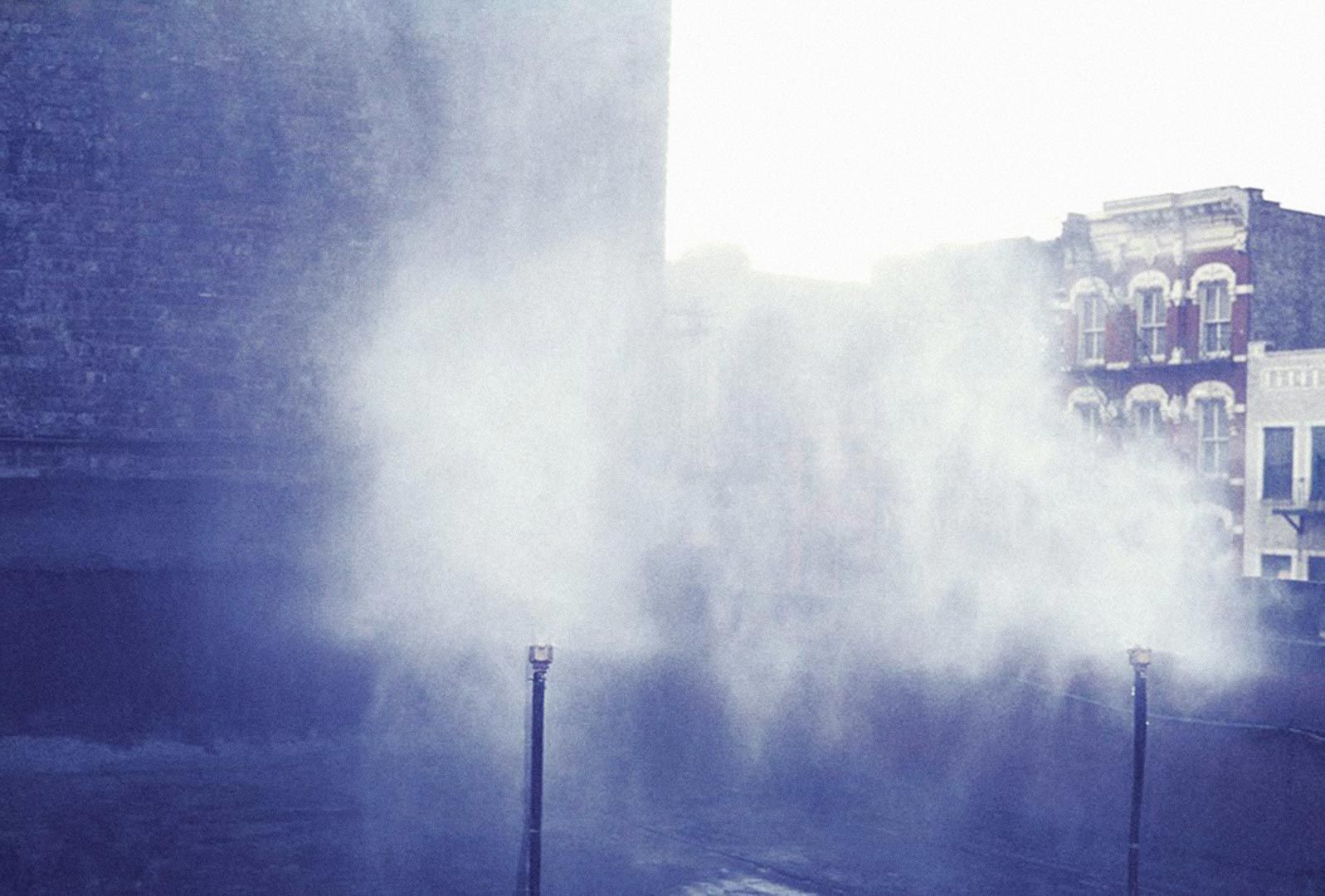
Water eludes a definitive form – it comes and goes, condenses, evaporates, and leaves traces. In the tension between visibility and disappearance, materiality and change, Permeable Condensation brings together artistic positions that explore water as a material presence as well as a medium of social, political, and affective relationships. As water changes its form from solid to liquid and gas, this exhibition focuses on the in-between states: the moment when the invisible becomes visible, the transition from vapor to drop, from absence to presence. Works by Eda Aslan, Hanne Darboven, Hans Haacke, Saodat Ismailova, and Helena Uambembe examine processes such as condensation, evaporation, and exhaustion, understood as expressions of this element that eludes a fixed form.
The exhibition title Permeable Condensation refers to a paradox: condensation describes a process of densification, of becoming material, while permeability signifies porosity, openness, and transition. In their connection, these terms describe a state in which boundaries become unstable – where the condensed simultaneously dissolves, where inside and outside, body and environment, visible and invisible merge into one another. Water is not only a physical phenomenon but also a medium that carries memory, emotion, and power. The works gathered in the exhibition navigate between dryness and abundance, between control and deprivation, and question how water shapes landscapes, permeates bodies, and determines political realities.
Water appears as a substance defined by relationality – as something that only comes into being through its connections, circulations, and transitions. In its ability to switch between physical states, water makes visible processes that elude linear control. In its chemical, scientific, and political entanglements, water is both essential and epistemic: it stores, transmits, and transforms meanings, affects, and power relations. Its distribution is unequal, its access regulated, its dynamics often unpredictable. From this perspective, water is an active component of social, ecological, and economic systems, in which fragility and dependence are inextricably intertwined. At the center of the exhibition is the tension between liquidity and power: water as a life-sustaining resource, as a connecting element, and at the same time as a politically and ecologically contested good.
Curated by Paula Kommoss and Talia Walther
*Cooperation of the Overbeck Society and St. Petri in Lübeck